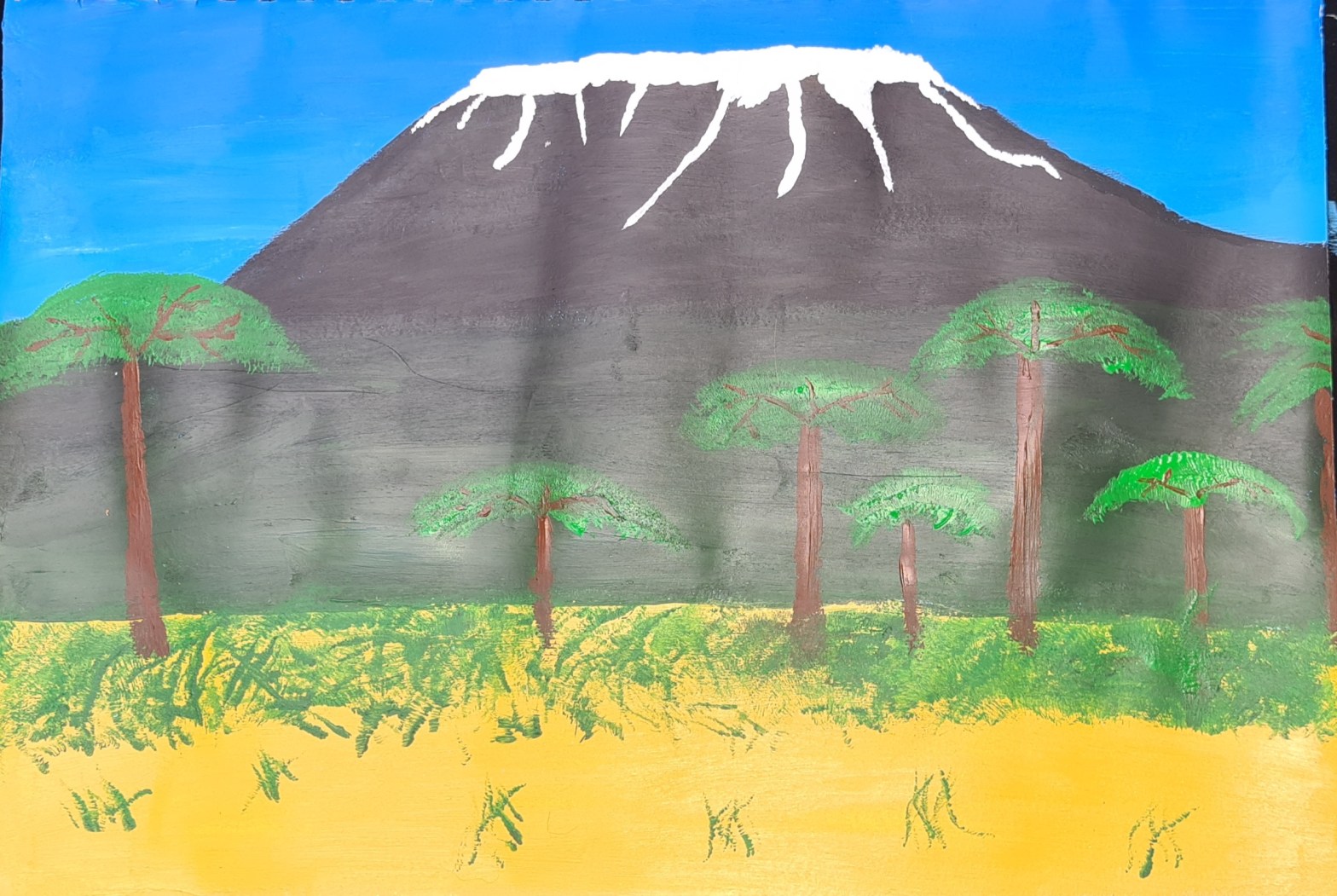
Another landscape painting was inspired by the amazing continent of Africa. This time, still remaining in sub-Saharan Africa but moving towards the equator. The iconic Mount Kilimanjaro stands tall in Tanzania.
Mount Kilimanjaro, similar to Table Mountain and Cape Town is on the “to visit” list. Climbing Kilimanjaro is a challenge that has been undertaken and completed by many people. A unique challenge is presented through the differing climates as the mountain is ascended. Starting from dense, humid forest and grasslands moving to the ice-cold summit which houses the last remaining glaciers on the continent of Africa.
Mount Kilimanjaro has always been an interest for many reasons, not just for the challenge of climbing the peak, which stands at 5,895m (19,341ft) above sea level, but for its geographic features. Mount Kilimanjaro is the highest volcano on the continent of Africa and is also deemed the highest free-standing peak in the world. You may be thinking, but Mount Everest is the highest natural point on Earth, right? It is. However, Mount Kilimanjaro is a stand-alone mountain, and is not part of a formed mountain range, like Mount Everest is part of the Himalayas range.
Further, as mentioned earlier, Mount Kilimanjaro houses the last remaining glaciers on the continent of Africa. The impacts of climate change and the continuous warming of the Earth have meant that scientists now predict that the glaciers on the top of Kilimanjaro could have melted completely at any point from 2025 to 2035. The unique presence of glaciers at the top of the mountain has, therefore, as can be imagined, been a focal point for climate scientists in recent years.
Right, so with the background of the mountain now covered and explained, what was it about Mount Kilimanjaro that inspired the creation? Well, for the first time since starting this hobby, painting somewhere overseas wasn’t the sole purpose of the creation. Travel has been missed throughout the pandemic but at the time of producing this creation, October 2021, the world had re-opened from the lockdowns and travel was returning to how we once knew it.

So what was the reason behind the creation then? One reason was the significance of the mountain being a live climate science laboratory – as the landmark Conference of the Parties meeting was set to be hosted in Glasgow in November 2021, the conference known as COP26. This conference is an annual United Nations conference that, sees climate change discussed and actions agreed upon by negotiators, diplomats and elected representatives of all 193 nations, including the UK.
Also, Kilimanjaro is a near-instantly recognisable landmark of the mid-African landscape and one that would mean that a blending of paints technique could be applied as the landscape changes from savannah, to the dense humid forest, to an open rock face and finally an ice-covered summit. The meteorological (typical weather) setting, given the geography of the mountain, being close to the equator, means that there is often a clear blue sky with very little cloud presence.
So, in short, the creation of Mount Kilimanjaro was reasoned as it was of interest but also allowed the development of the technique of blending with acrylic paints to create a full artwork.
This blog post is available in audio as a podcast and can be found here: Mount Kilimanjaro audio
 Artwork in Progress
2 thoughts on “Mount Kilimanjaro”